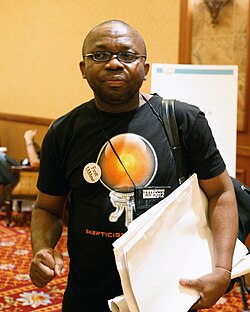
#2 Leo Igwe, Humanists International, Critthink Africa.
In this series of interviews I talk to P4C-practitioners around the world about how they started their practise of philosophizing with children. In 2021 Leo Igwe held the first teacher training on critical thinking in the state of Oyo, Nigeria. He is still looking for ways to get materials to spread his practice. Because it is highly necessary!
How did you start the practice of Philosophy for children (P4C)?
Doing my PhD in religious studies and my Master in Philosophy I first came across the topic of P4C. I thought: ‘Philosophy is not a childish thing, so philosophy is not for children.’ So I didn’t pay attention to it, and didn’t bother reading about it.
While I was studying I observed many students have challenges with their professors. They were not thinking critically which raised many issues. Professors had to keep telling them to look critically at the literature, that they should interrogate the data and do research on their own. What is missing in the educational system is echoing in the challenges students heave: critical thinking is not emphasised in school system.
Nowadays these are the most wanted skills! Why did we miss this?
I asked myself what subjects could deliver these thinking skills. That is when P4C came to mind. It felt like coming back home when I found it.
So I did my research. The questions I had to address was how to present P4C in primary schools, making it elementary and not too complex. I decided not to call it philosophy for children. Critical thinking resonated better, because it connects verbal and quantitative thinking (maths), which is also just critical reasoning. The goal of our national policy is to teach children to think critically, so it was not hard to lobby.
The problem was how to teach, measure and operationalise critical thinking for children who are still learning grammar and mathematical operations. There are many ways to give meaning to critical thinking, but none are elementary. That is how I came to the subject of generating questions. This has definitely a meaning that speaks to our school teachers.
In education, we emphasise : the teacher knows it all. The children don’t do anything, they just read, memorise and give it back on their exams. Teachers generate questions, children generate answers. Therefore, answers are a mark of knowledge. Questioning is just the teachers skill.
My research taught me that questioning is not only a way of getting answers, but also an demonstration of intelligence. It is a test of what is not clear, of what is not known. Asking questions is a demonstration of knowing how to test knowledge. I realised that children are intelligent, because they ask question all the time.
I couldn’t see any better way of operationalising p4c than challenging ideas by a question storm or an interrogation storm, like a brain storm. In my part of the world that was a real paradigm shift: teachers only acting as a guide. They guide children developing their ability to question. They teach by the means of tools to help express their curiosity and intelligence. The Question Storm is a way of teaching and a way of learning at the same time.
Children should not have to copy notes. Teachers should instead bring materials into the classroom to question. Children should participate in their own education, by generating questions to what they are told. They have to learn to respond to questions and answers with questions. It is also the way they should be assessed, in all of the subjects. Don’t look for the answers, look for the questions. Everything is conditional.
I see a shelf of books behind you. I want children to ask questions like: do all these books mean that you have, read or only bought bunch of books? Does your bookshelf tell me you are a professor?
Are teachers happy with the paradigm shift?
No. They feel like students put them on the spot. Teachers feel they have become less powerful. I teach them they are mistaken. Questions are for the sake of the questions. I tell them: Be happy with intelligent and difficult questions. Your work is done! You should be proud and go home (hahaha).
You see, there is nothing wrong with saying you don’t know. It gives room for questions and room for research. Childern can also explore new ways of thinking, new perspectives. That is the whole idea. What does it mean to say to children that adults have all the answers? Nobody knows it all.
The system is not very helping. The change is interesting but not so many are interested. There is no recondition by the government. So I am still open to know how P4C is delivered in other countries. It is not just my subject!
What material are you working with?
I work with materials that suit the students. I reframe ideas to their own situation, to local realities. Children are not at the liberty to ask questions. It is merely an academic exercise. There are a lot of cultural problems, which is a serious pushback. We reply by showing how important it is when looking at our concerns.
How do you address the problem of speaking freely and critically?
P4C is critical thinking in terms of questions instead of answers or memorising knowledge. I bring children together to think in terms of questions. Why do we have raining season? Or I take them to the zoo and invite them to ask any question, and to interrogate each other’s questions. I don’t do philosophy about sentiments, but I let them exercise them. This is a robust system of p4C which resonates with my part of the world.
Teacher training is a matter of winning the teachers over. Teachers and principals have never learned it, and don’t know anything about it. There is some prejudice. So I break it down to a form in withs childern can perform intelligently.
I take the problem of helping students to approach their examination. Some have serious exam fever. When childern are used to asking questions themselves, exams will become easier, because they are used to it.
Sometimes students cheat by using Chat GPT. But if you have the questioning skills, than you can be one step ahead of the teachers examining you. When you are reading a passage, and start interrogating critically already, you will have the same questions the teacher has.
What is your next challenge?
My next challenge is making the materials I have developed available. My approach is revised all the time. We have to make them available at the latest version of each revision. The material must be paid for, so we can keep on materialise it. I need a foundation that help me to provide. I also need promotional stuff, not just books and charts. To make sure foundations will value my approach to P4C, I need time, conferences spaces and support, so it can trickle down. So I need foundations to buy into the idea.
#1 in deze serie interviews, met Judith Wagensveld lees je hier